









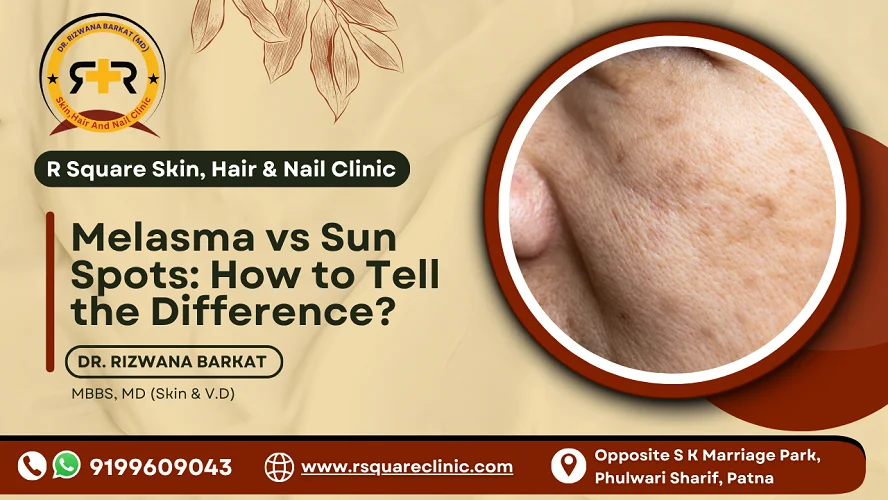
Melasma and sun spots can both show up as darker patches on your skin. But they’re not the same condition, and honestly, they don’t even behave the same way.
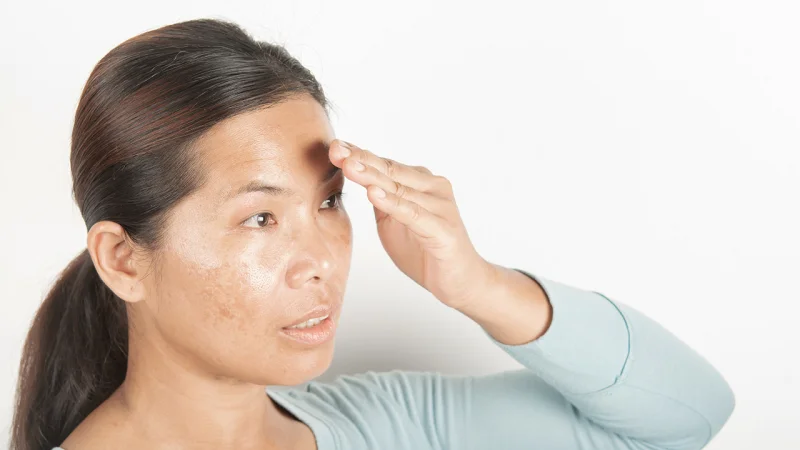
Melasma usually spreads across the cheeks, forehead or upper lip in a fairly symmetrical pattern, and hormones plus UV light exposure tend to be behind it.
Sun spots are different. They’re usually individual marks that build up wherever your skin has taken the most sun over the years: hands, shoulders, chest, face.
Where they show up, what colour they are, what sets them off, all of it can differ, and so does the treatment. If you’re not sure whether your pigmentation is melasma or sun spots, the best dermatologist in Patna can actually look at it and tell you before you start anything.
Pigmentation overlaps in appearance more than people expect, so a mirror check only gets you so far. At R Square Clinic, Dr. Rizwana Barkat sees cases like this every week and can usually tell you within one visit which one you’re looking at.
Now that you know the broad picture, let’s look at how these two actually compare side by side.
Melasma vs Sun Spots: What Is the Difference?
| Feature | Melasma | Sun Spots |
| Appearance | Larger, irregular patches | Usually well-defined individual spots |
| Colour | Brown, grey-brown or darker patches | Tan, brown or darker spots |
| Common areas | Cheeks, forehead, upper lip, nose | Face, hands, shoulders, chest and other sun-exposed areas |
| Main association | Hormonal changes plus UV/visible light and other factors | Cumulative UV exposure |
| Pattern | Often symmetrical | Usually individual or scattered |
| Course | Can persist or recur | May gradually become more noticeable |
These are general patterns, not a diagnosis. Two people can have pigmentation that looks almost identical on the surface and still be dealing with completely different underlying causes.
That’s really the point of a table like this: it’s a starting point for a conversation with a dermatologist, not a replacement for one.
Colour depth can mislead you too. A light brown patch and a dark brown patch can both turn out to be melasma, it just depends on how deep the pigment sits. So yes, a side by side chart only takes you so far.
>> Book a Consultation for the Right Diagnosis

What is Melasma?
Melasma is a pigmentation disorder that shows up as darker patches, usually on the face. It tends to appear symmetrically, mirrored patches on both cheeks, or a band running across the forehead, rather than as scattered individual marks.
Hormonal shifts can trigger it, sure, but that’s not the whole story. Visible light and everyday sun exposure worsen it too, and that includes light coming through a car window or an office lit mostly by daylight.
This is what makes melasma genuinely frustrating: it can fade with treatment and then quietly come back months later if the triggers aren’t managed. And it’s not really fair to blame it entirely on pregnancy or hormones either.
Plenty of people get melasma without either being the main driver. If you’re already dealing with it, our detailed guide on melasma treatment in Patna goes through the options in more depth.
Sun spots work a little differently, so here’s where the comparison gets more specific.
What are Sun Spots?
Sun spots are patches of increased pigmentation that build up from cumulative UV exposure, over months, sometimes years. You’ll usually find them wherever skin has spent the most time in the sun: the face, the backs of the hands, shoulders after a beach holiday, or spots where you kept forgetting to reapply sunscreen.
Unlike melasma’s broader patches, sun spots stay more localised, and they often become more noticeable with age simply because the exposure keeps adding up.
This is also why sun protection matters for a lot more than just avoiding sunburn. Not every brown spot is a sun spot, by the way.
Some are freckles, some are early signs of other pigmentation conditions, and telling them apart actually matters for treatment. There’s more detail on our sun spots treatment in Patna page.
So, how do you actually tell which one you’re dealing with?
Melasma vs Sun Spots: How Can You Tell Which One You Have?
There’s no single clue that gives it away on its own. Usually it’s a mix of where the pigmentation sits, how it’s shaped, and what seems to trigger it.
Location
Melasma commonly shows up on the cheeks, forehead, upper lip and other central facial areas. Sun spots tend to appear individually across sun-exposed areas, hands and shoulders included, not just the face.
Pattern
Melasma is usually symmetrical and spreads as connected patches. Sun spots are more discrete, standalone marks that don’t mirror each other across the face.
Trigger
Hormones combined with light exposure tend to drive melasma. Sun spots track more closely with cumulative UV exposure over the years, hormones don’t really factor in.
Appearance
Melasma patches tend to have blurred, uneven borders and blend into the surrounding skin. Sun spots are usually sharper edged and stand out more clearly against normal skin.
Appearance alone can’t always settle it, though. Other pigmentation disorders can look remarkably similar on the surface, and a dermatologist may need to examine your skin directly (sometimes with tools beyond the naked eye) before recommending anything. Some people even have both conditions at once, which makes a self check even less reliable than it sounds.
Since the two conditions can look alike but behave differently, it’s worth asking whether they’re even treated the same way.
>> Only a Dermatological Evaluation can Help You Find the Pigmentation Cause
👉 Visit R Square Clinic for a Diagnosis
Can Melasma and Sun Spots Be Treated in the Same Way?
Not necessarily. Treatment comes down to several things at once:
- the type of pigmentation,
- how deep your pigmentation sits,
- your skin type,
- how severe the pigmentation is,
- what’s actually triggering the pigmentation,
- whatever you’ve already tried,
- and your risk of post-inflammatory hyperpigmentation.
Someone with deep-seated melasma and sensitive skin needs a completely different approach than someone with a few superficial sun spots, even if both look like roughly the same shade of brown in a photo.
Broad treatment categories include:

- topical treatments,
- chemical peels,
- laser or light-based treatments,
- medical facials or skin rejuvenation approaches,
- and consistent photoprotection.
None of it is one-size-fits-all. A treatment that clears sun spots in a handful of sessions can actually aggravate melasma, because melasma-prone skin tends to respond to heat and irritation by making more pigment, not less.
That’s the opposite of what you’re going for. It’s why dermatologists usually start conservatively with melasma and only layer in stronger options once they see how the skin responds. Our anti-pigmentation treatment page covers the range of approaches used at the clinic, from topical regimens through to procedure-based options.
- Sun spots generally allow for a more direct approach, since the pigment sits closer to the surface and the surrounding skin isn’t as reactive.
- Skin type still matters though. Darker skin tones carry a higher risk of rebound pigmentation from anything too aggressive, so the intensity of a session gets adjusted rather than kept standard for everyone.
- Some patients assume a stronger session automatically means faster results. It doesn’t, really; pushing intensity too far on reactive skin tends to slow recovery down and can leave temporary redness or sensitivity behind.
- A gradual approach, spread across a few sessions, usually holds up better over time than one aggressive round. This is also where a patch test or trial session earns its keep. It gives the dermatologist a read on how your specific skin reacts before committing to a full course.
A chemical peel may be one option depending on your skin, sometimes paired with maintenance sessions spaced a few weeks apart. Whatever the plan ends up being, it’s built around what your skin actually needs, not just what the pigmentation looks like on day one.
Getting the treatment wrong isn’t just a wasted appointment. It can genuinely set your skin back.
>> Consult for the Right Treatment – Book Appointment
What Happens If You Treat the Wrong Type of Pigmentation?
The same treatment doesn’t suit every type of pigmentation, and using the wrong one can genuinely backfire.
Aggressive treatments applied to the wrong condition can cause irritation, and on skin that’s already prone to pigmenting easily, that irritation can trigger even more discolouration, sometimes worse than what you started with.
Melasma is particularly unforgiving here. It can recur on its own, and piling unnecessary irritation on top of unmanaged triggers just makes that more likely.
A treatment picked for sun spots, applied to melasma instead, can end up deepening the very patches it was supposed to fade, simply because the skin’s underlying behaviour wasn’t accounted for.
This is really the whole argument for getting a proper diagnosis before jumping into anything aggressive, instead of treating pigmentation like one problem with one universal fix. It’s also why the results your friend got, or something you saw work online, don’t always translate to your own skin.
How a Dermatologist Diagnoses Melasma and Sun Spots?
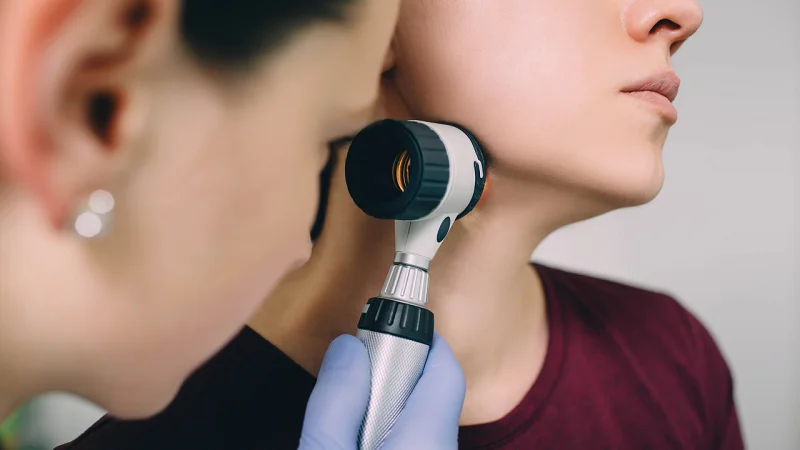
Diagnosis isn’t a single test. It’s a combination of what the dermatologist sees and what you tell them. Dr. Rizwana Barkat, who leads dermatology care at R Square Clinic, follows a structured process with every patient before recommending a treatment plan:
- Visual examination of the pigmentation’s distribution and pattern. Symmetrical patches versus scattered spots is often the first clue.
- Patient history, including how long the pigmentation has been there and whether it’s changed recently.
- Sun exposure history, since cumulative exposure points more toward sun spots.
- Hormonal factors, where relevant, especially for pigmentation that appeared or worsened around a hormonal change.
- Previous pigmentation treatments and how the skin responded to them.
- Skin type and sensitivity assessment, which affects which treatments are safe to use.
- Additional examination tools, used when clinically appropriate to get a clearer read on how deep the pigmentation sits.
Once you know what you’re dealing with, prevention becomes a more useful conversation.
How to Prevent Melasma and Sun Spots From Getting Worse?
Broad-spectrum sunscreen is the baseline, applied consistently rather than only on obviously sunny days. Reapplication matters more than people expect, especially if you’re outdoors for extended periods.
Physical protection (a wide-brimmed hat, seeking shade during peak hours) adds a layer sunscreen alone can’t fully cover. It also helps to avoid unnecessary skin irritation, since that can worsen existing pigmentation, and to stick with a dermatologist-recommended skincare routine rather than switching products often.
Where specific triggers are known, managing them matters too.
Sunscreen alone won’t completely prevent melasma, but it meaningfully reduces how much it can flare. Our guide on skin care during summer has more practical tips for the hotter months.
When Should You See a Dermatologist for Facial Pigmentation?
It’s worth booking an appointment if:
- Pigmentation appears suddenly, without an obvious cause.
- A patch changes noticeably in size, shape or colour.
- Pigmentation keeps coming back after treatment.
- Multiple treatments haven’t worked so far.
- Pigmentation seems to be getting worse rather than better.
- You’re simply not sure what you’re looking at.
- There are any unusual changes in a pigmented area.
If you’re dealing with persistent or unclear pigmentation, getting informed about the facial pigmentation treatment in Patna is a good next step. Consult Dr. Rizwana Barkat to get a clear answer instead of guessing.

FAQs
1. Is melasma the same as sun spots?
No. Melasma appears as broader, often symmetrical patches linked to hormones and light, while sun spots are individual marks caused by cumulative UV exposure.
2. How can I tell whether I have melasma or sun spots?
Look at location, pattern and appearance as rough clues, but a dermatologist’s examination is the only reliable way to confirm which one you have.
3. Which is harder to treat, melasma or sun spots?
There’s no universal answer. Difficulty depends on severity, skin type, how deep the pigmentation sits, and what’s triggering it.
4. Can sun exposure make melasma worse?
Yes. UV and visible light exposure can worsen melasma, which is why consistent photoprotection is central to managing it.
5. Can chemical peels or laser treatments treat both melasma and sun spots?
Sometimes, but the right choice depends on an accurate diagnosis and your individual skin characteristics, not on the pigmentation alone.
6. Can pigmentation come back after treatment?
It can, especially melasma. Ongoing sun protection and maintenance treatment reduce the chances of recurrence.
Seek Care for Pigmentation Concerns
Melasma and sun spots can look similar at first glance, but their causes, patterns and treatment needs are often quite different. Getting the identification right matters, because a treatment that helps one can do very little for the other, or even backfire.
A quick glance in the mirror won’t tell you which one you’re dealing with, and neither will a generic skincare routine built for “pigmentation” as some single category.
What actually helps is knowing whether hormones, light, sun exposure, or something else entirely, is driving the discolouration. That’s the thing that shapes every decision after it, from which treatment to start with to how long you’ll need to stay on it.
If your pigmentation is persistent, changing, or just hard to pin down, it’s worth getting a professional opinion instead of guessing. Consult a dermatologist at R Square Clinic for pigmentation solutions after it’s properly diagnosed and assessed.


