










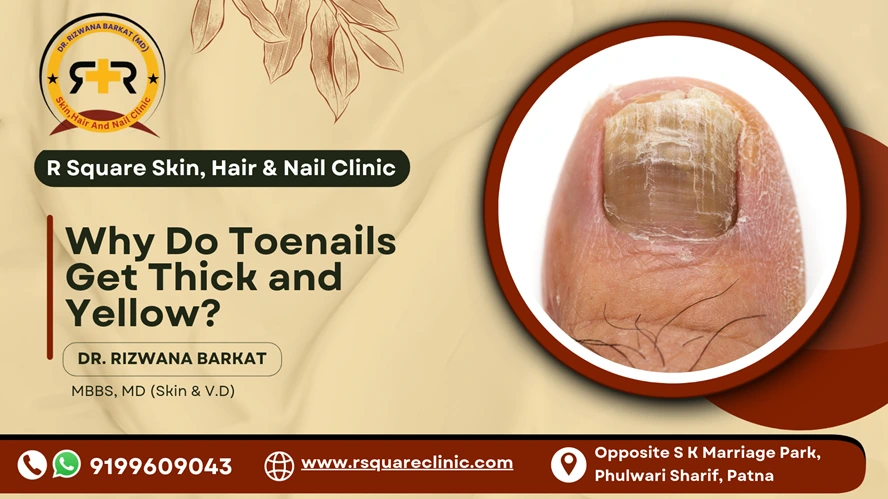
Thick, yellow toenails are a common concern. They can change how your feet look, make footwear uncomfortable, and sometimes make walking painful.
These changes usually develop gradually and may be linked to fungal infections, repeated pressure, ageing, or certain skin conditions. This blog highlights what can cause these toenail changes and treatment choices .
Let’s delve into the causes of the thick and yellow toenails from fungus to the nail trauma. We’ll also discuss the diagnosis of the changes and what can be done to get rid of them.
Why Do Toenails Get Thick and Yellow?
An altered nail plate or a change in the manner a nail grows, or in the nail bed underneath it, leads to toenails getting thick and yellow.
These kinds of changes can be attributed to different reasons such as fungal nail infection (onychomycosis), constant pressure or damage, age related changes, and nail psoriasis. Rarely, other medical problems can be a factor too.
A fungal infection is a fairly common reason, nevertheless, just from the changes in nail colour and nail thickness it is hard to definitely identify the infection. Since various diseases can look alike, understanding the cause is essential.
>> If You Notice These Changes, Consult a Dermatologist To Identify The Cause.
Common Causes of Thick and Yellow Toenails
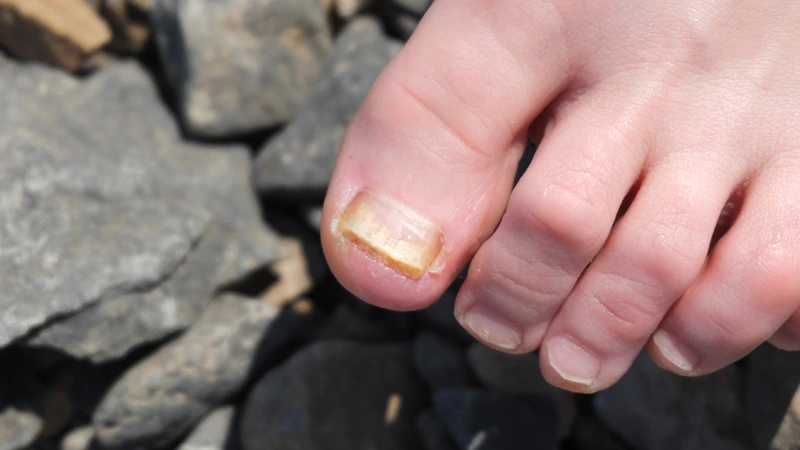
Different conditions may alter the toenails in terms of their colour, thickness, and roughness, and many exhibit similar symptoms. The major ones include the following:
1. Toenail Fungus (Onychomycosis)
Fungal diseases affect the nail plate as well as the surrounding structures. The nail gets yellow, white, or brown colour and then thick, fragile, and easily breakable. There is often a build up under the nail.
The infection might get to the adjacent toenails or the surrounding skin. If you live in Patna or somewhere around, getting an early fungal nail infection treatment in Patna can limit its spread.
2. Repeated Pressure or Nail Injury
Footwear which is too tight, continued rubbing, sports as well as accidental knocks may all be the cause of injury to the toenail. Recurrent trauma can result in thickening, discolouration, or distorted growth.
The changes may continue to be visible for a long period of time even after the wound has been completely healed as the nail matrix that had been hurt might keep on generating an abnormal nail.
3. Age-Related Nail Changes
In many, if not most circumstances, the elderly have toenails that often become thicker, harder, and more brittle, and they grow more slowly.
The nail structure also goes through transformation. On the other hand, yellow nail colouration shouldn’t be interpreted automatically as a sign of old age.
Having yellow toes is definitely something that should not be looked down upon. The only sure way is to checked by a dermatologist who can tell for sure what the real cause is.
4. Nail Psoriasis
Nail psoriasis has the potential to affect both the nail matrix and the area under the fingernail.
The psoriasis might show the nail as being yellow to pinkish colour patches and also lead to the occurrence of pits, raised areas, separation of the toenail from the nailbed as well as crumbling and cracking.
While nail psoriasis is not contagious, it may still be mistaken to look as if the one is having a fungal infection. Distinguishing between nail psoriasis vs fungal infection is a key factor because the two have quite a contrasting way of treatment.
5. Other Medical Conditions
Less commonly, conditions such as poor circulation together with yellow nail syndrome may influence your nails.
There are chances that one of these problems may not even be suspected unless one has a close examination by a specialist.
One should not associate a yellow toenail with any type of health issue. In most cases it is nothing more than a common local cause.
What Are the Symptoms of Thick and Yellow Toenails?
Exactly what kind of change one can observe depends solely on the underlying disease, and there certainly isn’t a list of symptoms where all of the changes appear at the same time.
Common signs include:
- Yellow, white, brown, or dull discolouration
- Very hard or thickened nails
- Easily broken with sharp corners and roughness
- Loosening of the nail at the nail bed
- Debris collecting under the nail
- Changes in nail shape or growth
- Discomfort or pain in some cases
Such transformations might occur bit by bit, or only become apparent as the nail health gets worse. Their appearance can also offer useful clues about the type of nail problem, in turn assisting a dermatologist to determine the need for more testing or not.
>> Concerned About These Symptoms? Book Your Consultation Today!

How Are Thick and Yellow Toenails Diagnosed?

A dermatologist should examine the nail rather than relying on appearance alone. Diagnosis usually involves the following:
- Physical examination: The appearance of the nail will be checked for any changes in its colour, thickness and texture, along with the surrounding skin.
- Medical history: The patient’s history will be asked to find out if there was any injury, type of footwear, skin conditions and other symptoms.
- Nail testing: Nail clippings or scrapings may be analyzed under the microscope, or submitted for fungal culture, or even undergo other laboratory tests if the situation demands it.
If a fungal nail infection is confirmed, your dermatologist may prescribe oral antifungal medication depending on its severity. Getting the right treatment for nail disorders in Patna starts with understanding what’s causing the problem and choosing an approach that suits your condition.
How We Treat Thick and Yellow Toenails at R Square Clinic?
R Square Skin, Hair & Nail Clinic is led by Dr. Rizwana Barkat, MBBS, MD (Skin & V.D.). At our clinic, treatment does not rely on the appearance of the nail but rather on the cause of the problem.
We begin by figuring out what is triggering the nail change. This way, we can get an idea about the problem and suggest the right treatment method for the patient’s nail health. The main types of treatment are given below.
1. Antifungal Treatments
In a few cases of mild infections, topical antifungal nail treatment may be prescribed. On the other hand, for widespread or long term infections, oral antifungal medicines could be a treatment choice.
These are prescribed medicines that require medical supervision. Toenails do not grow much in a short time and therefore, restoration of a completely healthy nail state will most likely take several months.
2. Nail Trimming and Debridement
A healthcare professional can carefully cut away any overly thick parts of the nail and discard the damaged pieces.
Most definitely, patients will become more comfortable wearing their shoes and easier to take care of their toenails this way.
Nevertheless, this method doesn’t always stop the ongoing infection. If there is an ingrown toenail adding to the problem, then ingrown toenail treatment in Patna can tackle that separately.
3. Treatment for Underlying Nail Conditions
Nail psoriasis, repeated trauma, and other medical conditions need cause-specific treatment. Antifungal medication will not help when the problem is not fungal.
4. Laser Treatment for Toenail Fungus
Some clinics offer laser procedures for fungal nail infections. Evidence of their effectiveness remains limited, and results vary. Laser treatment is not a guaranteed cure or a replacement for established antifungal treatment.
How Can You Prevent Toenails From Becoming Thick and Yellow?
Good foot and nail hygiene can lower the risk of infection and repeated nail damage. Some simple habits help are listed below:
- Keep toenails clean and do not cut them uneven but straight across.
- After bathing, make sure to completely dry your toes as well.
- Wear comfortable, properly fitted footwear.
- Change socks regularly and avoid prolonged moisture.
- Wear footwear in communal showers and swimming areas.
- Avoid sharing nail clippers and other nail-care tools.
- Treat the athlete’s foot promptly.
See a dermatologist if your toenails continue to thicken, change colour, become painful or show signs of infection. Getting a diagnosis from a dermatology clinic in Patna will help determine the underlying condition and a treatment plan will be prescribed accordingly.
FAQs
1. Can thick yellow toenails become normal again?
They can improve, as long as the underlying cause is treated. How much the nail bounces back depends on how much damage there is and how fast it grows.
2. Does a thick yellow toenail always mean fungus?
Not always. An injury, aging, psoriasis and other conditions can cause the same changes.
3. How long does it take for a thick yellow toenail to heal?
Be patient with this one. Toenails grow slowly, so you may need to wait several months to see a visible difference, even when treatment has worked.
4. Can I remove thick yellow toenails at home?
Trimming and basic care may help. Aggressive filing, digging beneath the nail, or harsh chemicals can cause injury.
5. Can toenail fungus spread to other nails?
Yes, it can. If a fungal infection is left untreated, it can spread to other nails or the skin nearby.
Get Expert Care for Thick and Yellow Toenails
Call a dermatologist if you feel the nail constantly thickens, changes its colour, is painful, or there is an infection in it.
Persistent infection and the colour change of nails could be the result of other underlying conditions as well.
Therefore, before deciding on a proper treatment, one must find out and understand exactly what the problem is. At R Square Skin, Hair & Nail Clinic, Dr. Rizwana Barkat offers professional evaluation and personalised treatment guidance.
Book an appointment at R Square Clinic for professional assessment of your nails. Also, get expert advice from Dr. Rizwana Barkat to discover the cause of your nail problem and what treatment will be appropriate.


