


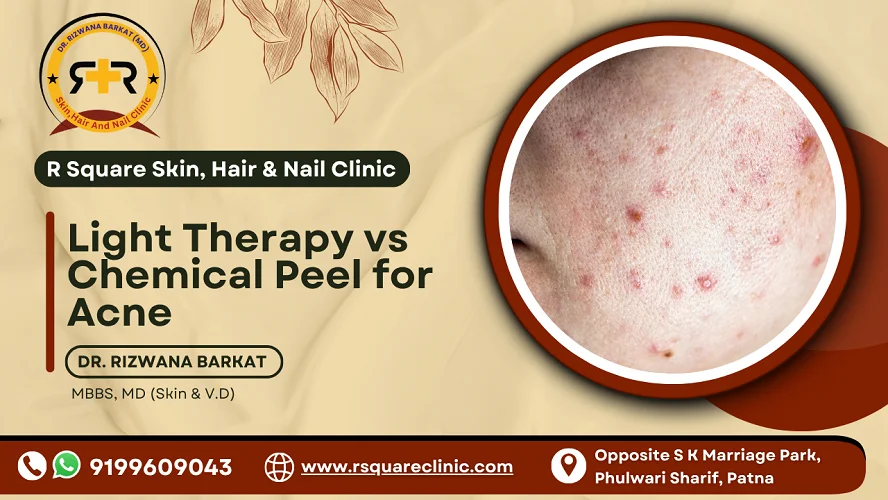
If you are looking for a non-surgical treatment for acne issues that persist, then first of all, you must have wondered about two popular treatment options, i.e. light therapy for acne and chemical peel for acne scars. Both of them are in pretty high demand.
The global market for acne drugs, in fact, was worth almost USD 9.22 billion in 2023 according to the Grand View Research report, but still, acne patients are often quite confused about which acne treatment they should choose.
Short answer: neither of them is globally more effective than the other. Your acne treatment choice should be based on your acne type, skin sensitivity, and if you are currently having acne breakouts or just acne scars.
Light therapy is effective for inflammatory acne and is safe for sensitive skin. On the other hand, chemical peels work better on clogged pores, discoloration, and light scarring.
What matters most is your specific skin situation, not which treatment sounds more appealing. If you’re looking for acne treatment in Patna, a proper skin assessment at R Square Clinic is where this decision should actually start.
The sections below compare both treatments across different parameters that actually matter before your consultation.
Light Therapy vs Chemical Peel: Key Differences
| Factor | Light Therapy | Chemical Peel |
| Best For | Inflammatory acne | Oily/acne-prone skin |
| Downtime | Minimal | Mild peeling |
| Effectiveness for Acne Marks | Moderate | Good |
| Effectiveness for Active Acne | Excellent | Good |
| Sensitive Skin Suitability | Better option | Depends on peel strength |
One works through targeted wavelengths of light. The other uses controlled chemical exfoliation. They address acne at different skin levels, which is why they’re not interchangeable and the question isn’t really “which is better” but “which one fits your skin.”
1. Mechanism
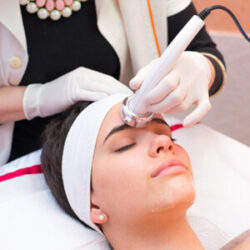
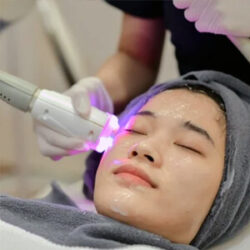
Light therapy is based on the use of certain wavelengths such as blue light therapy for acne at 415 nm wavelength which targets Cutibacterium acnes bacteria killing them and also reducing the inflammation of sebaceous glands. There are no chemicals involved and nothing is being put on the skin surface.
Chemical peels on the other hand act differently. An acid solution (glycolic, salicylic, TCA, or VI Peel) is used to exfoliate the skin chemically, clean the pores, and also enhance collagen synthesis in the deep layers of the skin.
2. Downtime
With light therapy, there’s minimal to no downtime. Some patients notice mild redness for a few hours, but you can return to your normal routine the same day.
Chemical peels are less predictable on this front. Superficial peels mean 2–5 days of peeling. Medium-depth peels can stretch to 7–10 days. So, it’s worth planning before you book.
3. Suitability
If your skin is sensitive, dry, or prone to rosacea, then definitely light therapy is a great option for you. Besides, if you have a chemical sensitivity or are allergic to the acids used in peels, then in such cases, light therapy is by far the best option.
However, chemical peels are the best choice for oily skin and those suffering from the problem of clogged pores, comedonal acne, or post-acne pigmentation. You should not use them if you have highly reactive or infected skin.
4. Pain and Discomfort
Light therapy is almost painless for most people; just a mild warming sensation is noticed during the treatment. No anaesthesia or numbing cream required.
Chemical peels sting. Mild to moderate burning or stinging is noticeable on application, especially with salicylic or TCA-based formulas. A cooling fan or topical numbing cream helps manage this during the session.
5. Acne Type
Light therapy is most effective for inflammatory acne, red papules, pustules, cystic lesions. It’s also used in IPL and chemical peel together treatments when a patient has mixed acne presentations.
Chemical peels target comedonal acne (blackheads, whiteheads) and mild-to-moderate inflammatory breakouts. They’re especially useful when oiliness is the main driver.
→ Consult Dr. Rizwana Barkat to Find Your Acne Type
Book Appointment at R Square Clinic
6. Scar Effectiveness
Light therapy is not very effective in changing the appearance of atrophic (depressed) scars. It primarily lessens the redness and swelling of post-acne marks, although it is not meant to be a solitary scar treatment.
Chemical peels are more suitable for superficial acne marks and mild post-inflammatory hyperpigmentation. The VI Peel, for example, has undergone clinical validation for its effectiveness in improving skin tone and addressing shallow scarring.
7. Sessions Required
Light therapy usually requires more treatment sessions, generally 6-10, with 1-2 weeks interval between each. Monthly maintenance sessions can be implemented for persistent acne cases.
Chemical peel treatments are normally 3-6 sessions for most acne issues, with 3-4 weeks gap between sessions.
You can learn more about single session plans and get an estimate for the entire course of sessions by reading our guide on cost of chemical peeling in Patna at R Square Clinic.
8. Cost
Light therapy sessions are moderately priced, but the higher number of sessions means the total programme cost adds up. No consumables are involved per visit.
Chemical peel costs vary depending on the type; a VI Peel costs more than a basic glycolic peel. Fewer sessions are usually needed, but deeper peels are pricier per visit.
Both treatments have trade-offs on cost. The better question isn’t which is cheaper, but which one your skin actually needs.
Which Acne Treatment Should You Choose?
Honestly, it comes down to what your skin is dealing with right now. A few patterns hold up consistently across patients.
Choose light therapy if you have:
If your skin is sensitive or reactive, or you’re in an active flare of inflammatory acne with red, swollen, inflamed pimples, light therapy is usually the safer bet. The same goes if you have rosacea or can’t tolerate chemical agents.
Choose chemical peels if you have:
If your skin is oilier, with clogged pores, comedones, uneven tone, or you have post-acne marks that won’t fade, a chemical peel tends to work better. It’s also the stronger option for mild superficial scarring.
That said, the best results often come from combining both. Using IPL alongside a superficial peel can address bacteria, pigmentation, and pore congestion at the same time; something neither treatment fully achieves alone.
At R Square Clinic, Dr. Rizwana Barkat builds treatment plans around your actual skin assessment. Not just treatment trends.

Other Treatments at R Square Clinic for Acne Scars
If you’re looking for the best acne scar treatment in Patna, the type of scar you have matters more than the treatment name. Superficial scars, flat discolouration, minor texture issues generally respond well to peels and light-based treatments.
However, deep atrophic scars (ice pick, boxcar, rolling) are a different problem. They need interventions that go below the skin surface.
Dr. Rizwana Barkat takes a multi-modal approach at R Square Clinic, selecting and combining treatments based on each patient’s scar profile, skin tone, and overall skin health.
1. MNRF (Microneedling Radiofrequency)
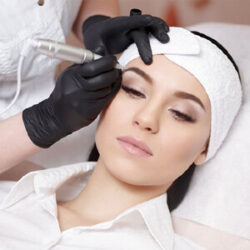
MNRF delivers radiofrequency energy through microneedles directly into the dermis. The result is controlled collagen remodelling with minimal surface trauma which matters because it lowers the risk of post-inflammatory pigmentation.
For deep atrophic scars (ice pick, boxcar, rolling types), it’s one of the most effective options available, and it works across all skin tones, including darker Indian skin types.
2. Laser Treatment for Acne Scars
Fractional and ablative laser machines work by resurfacing the outer layers of the skin and causing the production of new collagen.
Laser treatment for acne scars at R Square Clinic can be a good option for more severe scars that have not improved with peels. The intervals between sessions is 4-6 weeks, and the effect can get better for several months after the completion of the treatment.
3. Microneedling (Dermaroller/Dermapen)
Microneedling causes tiny injuries that are controlled and allow for collagen and elastin production that make the skin tighter and improve the skin texture.
It is effective on light-to-moderate rolling and boxcar scars, and is generally the first step before going to MNRF. Besides, it also helps with penetration of the topical serums after the treatment.
4. Subcision
Subcision is a minor procedure where a needle is inserted under a depressed scar to release fibrous bands that pull the skin down.
It’s specifically indicated for rolling and tethered scars with a visible pulling effect on the surface. Subcision is often combined with fillers or MNRF for more durable results.
5. PRP Therapy (Platelet-Rich Plasma)
PRP uses a concentration of growth factors derived from the patient’s own blood, injected into scarred areas to accelerate tissue repair. It improves skin texture and reduces redness from post-acne marks.
It is most commonly used alongside microneedling or MNRF rather than as a standalone treatment in order to improve results.
6. Dermatologist-Guided Topical Therapies
Topical medications of the highest quality such as retinoids, azelaic acid, niacinamide, and kojic acid preparations are part of most treatment protocols at R Square Clinic.
These not only help keep the effects of treatment but also lighten post-inflammatory hyperpigmentation and decrease the occurrence of new acne.
Neither in-clinic procedures nor a structured at-home routine alone can suffice in persistent acne cases. Hence, both are often used in combination for severe cases.
Single-treatment rarely brings about the best result in complex acne scarring. So, a thorough examination is more important than choosing the most popular procedure to identify the best combination of treatments for you based on your scar depth, skin type and personal skin goals.
Can Teenagers Benefit from These Treatments?
Adolescence is when acne peaks. Around 85% of people aged 12–24 experience minor acne at some point (American Academy of Dermatology) Source.
Hormonal changes during puberty ramp up sebum production, leading to clogged pores and frequent inflammatory breakouts particularly on oily teenage skin.
For teenage acne treatment in Patna, lighter interventions are the right starting point. Superficial salicylic acid peels are well-tolerated by most teenagers with oily skin. Blue light therapy offers a non-invasive option for those with sensitive or inflamed skin. Both are safe under dermatologist supervision.
What most parents don’t realise is that early treatment actually changes outcomes. Untreated teenage acne often progresses to post-inflammatory hyperpigmentation and permanent scarring that takes far more intensive treatment later. Getting a proper evaluation at R Square Clinic before scars form is genuinely worth it.
→ Consult Dr. Rizwana Barkat / Book Appointment for Teenage Acne
Discover Personalized Acne Solutions for Healthier Skin
There’s no single best treatment for acne and any source suggesting otherwise is glossing over how much this condition varies.
Whether light therapy, a chemical peel, or a combination approach is right for you depends on your skin type, acne severity, scar depth, and how much downtime you can manage.
Skin type and acne severity predict outcomes far more reliably than general recommendations.
At R Square Clinic, Patna, Dr. Rizwana Barkat (MBBS, MD Skin & V.D.) offers thorough skin assessments and personalised acne treatment planning. She combines modalities based on your specific condition, not a standard protocol. So, don’t guess what your skin needs. Get your skin evaluated.